MiddleCore/Products/Read & Confirm/User guide
Read & Confirm icon
RC · Confluence User guide

From published page to provable record.

This guide follows a real confirmation cycle through the screens you'll actually use — creating a request, what readers see on the page, automatic reminders, and exporting the record you'll be asked for.

Setup

Three steps from the Marketplace listing to your first tracked page.

Step 1

Install from Marketplace

Open the Read & Confirm listing on the Atlassian Marketplace and add it to your Confluence Cloud site. Billing and updates run through your existing Atlassian account, so there is no separate vendor login to manage.

Step 2

Approve access and open the app

On first launch, Atlassian lists the access the app requests; a site admin reviews and approves it. After that, open Confluence's Apps menu and choose Read & Confirm. The workspace sidebar has three views: Dashboard, My Confirmations, and Teams.

Step 3

Pick your starting point

Create a request straight from the dashboard — Read & Confirm embeds its panel on the chosen page for you. Or start from the page: type /Read in the editor to insert the macro, publish, and click "Create on dashboard" in its empty state. Either way you land in the same creation dialog.

Step-by-step

One full cycle, from a new request to the exported record.

  1. 01

    Start a new request

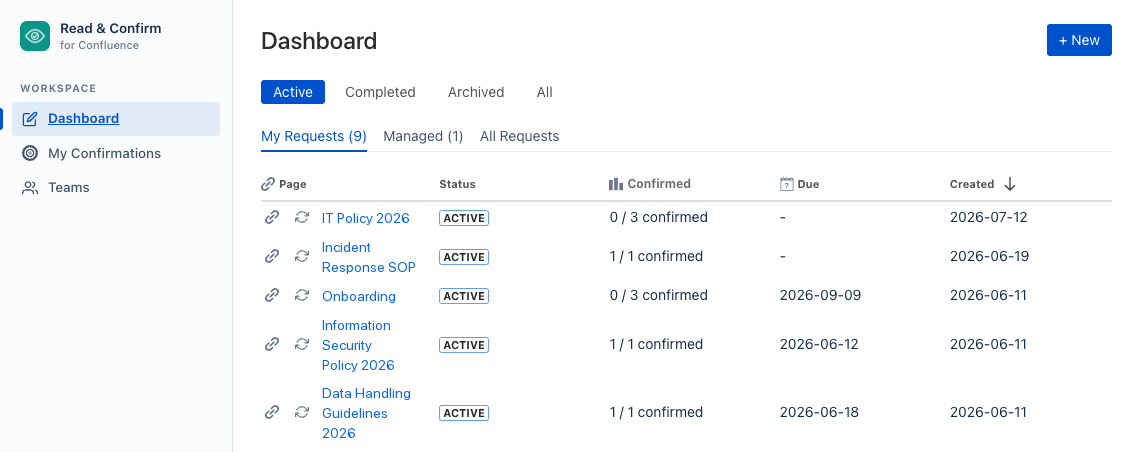
    Open the dashboard and click + New. The list behind it keeps every request in view — filter by Active, Completed, Archived, or All, and switch between the My Requests, Managed, and All Requests tabs as your collection grows.

    Read & Confirm dashboard listing active requests with status filters, tabs and the + New button
  2. 02

    Choose the page, the audience, the deadline

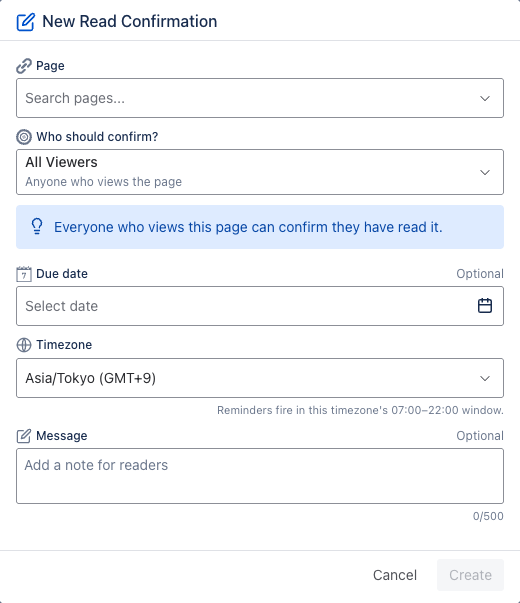
    In New Read Confirmation, search for the page, then decide who should confirm: specific people, a saved Team, or All Viewers — anyone who opens the page. Add an optional due date with its timezone, and an optional note for readers of up to 500 characters. Create embeds the panel on the page and notifies named readers with an @mention comment.

    New Read Confirmation dialog with page search, audience choice, due date, timezone and message fields
  3. 03

    Readers confirm on the page

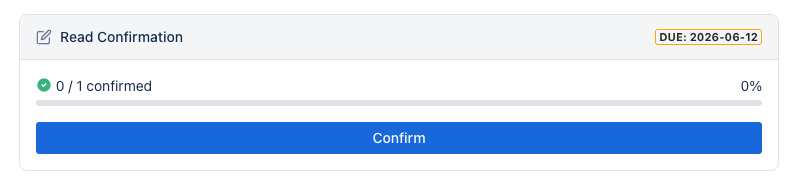
    On the page itself, the Read Confirmation panel shows the due date, live progress, and a single Confirm button. One click writes a timestamped record tied to the page version the reader saw — the panel then reads "Confirmed on …" with that version. If the page changes afterwards, the confirmation is flagged as outdated and a Re-confirm button appears.

    Read Confirmation panel on a Confluence page with due date, progress bar and Confirm button
  4. 04

    Reminders chase the rest

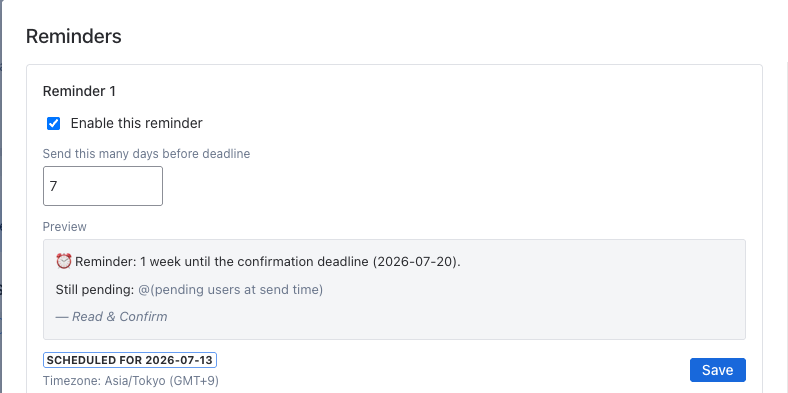
    Two reminder slots come pre-armed at 7 days and 1 day before the due date — adjust or disable them per request. Each fires as a page comment that @mentions only the people still pending, inside the 07:00–22:00 window of the request's timezone. The preview shows the exact message before it goes out.

    Reminders dialog showing an enabled 7-day reminder with a preview of the comment it will post
  5. 05

    Track, then export

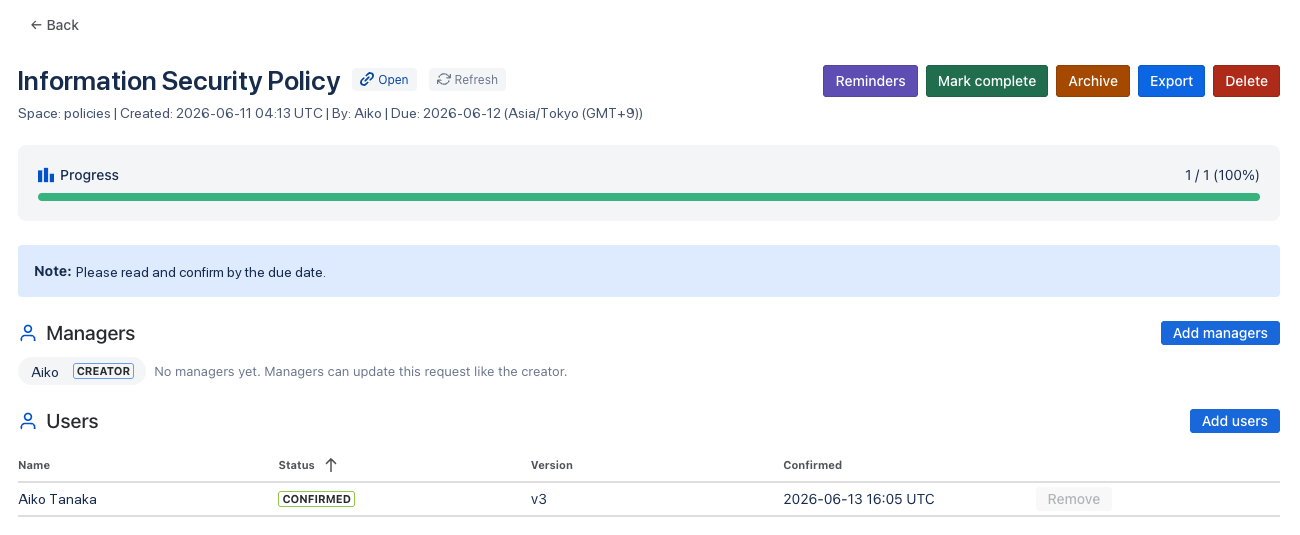
    The request detail shows overall progress and, per person: pending or confirmed, against which page version, and when. Add managers to share admin, mark the request complete, or archive it — and when someone asks for proof, Export downloads the full record as CSV: Name, Status, Version, Confirmed At.

    Request detail with progress bar, managers, per-user confirmation table and the Export button

Settings reference

What each control on a request does.

Who should confirm?
Individual Users (up to 100 per request), everyone from a saved Team, or All Viewers — anyone who opens the page can confirm. One request per page.
Due date & timezone
Optional. Shown as a DUE lozenge on the page panel, and it's what reminders count down to — they fire in the chosen timezone's 07:00–22:00 window.
Reminders
Two slots per request, enabled by default at 7 days and 1 day before the deadline, each adjustable from 1 to 365 days. Delivered as an @mention page comment to the people still pending; a slot that has already been sent can be reset and re-armed.
Teams & managers
Teams are site-wide member lists you reuse across requests — when a team gains members, affected requests offer to add them. Managers (up to 10) share full control of a single request with its creator.

Tips & best practices

01

Scope it to obligations

Reserve Read & Confirm for pages where acknowledgement carries weight — policies, SOPs, regulated notices. Used on everything, the signal that a confirmation means something gets diluted.

02

Let page versions do the proving

Every confirmation records the page version it was made against. When the page is edited, Read & Confirm flags earlier confirmations as outdated and offers a choice — reset confirmations, accept the latest version for everyone, or keep things as they are — so the record always says which words each person accepted.

03

Save recurring audiences as Teams

If the same department acknowledges every policy, save it once as a Team and pick it on each new request. When people join the team later, affected requests show "Team updates available" and add them in one click — no more reconciling member lists by hand.

FAQ

Where do our content and acknowledgement records live?
Read & Confirm is built on Atlassian Forge and runs inside your own Atlassian Cloud tenant. Page content and confirmation records stay in your Atlassian environment and never transit a MiddleCore server.
How is it priced, and is there a trial?
Read & Confirm is distributed through the Atlassian Marketplace, so billing, trials, and updates run through your existing Atlassian account. Current pricing is shown on the Marketplace listing.
Who can create requests, and who can see the records?
Anyone in your site can create a request for a page they can view, and becomes its creator; they can add up to 10 managers with the same rights. The tracking views are built for audit and handover: authenticated users in your site can open any request read-only and use Export, while only the creator and managers can change the audience, reminders, or lifecycle.
How do reminders reach people who haven't confirmed?
Automatically. Each request has two reminder slots, pre-set to 7 days and 1 day before the due date. At send time, Read & Confirm posts a comment on the page that @mentions only the people still pending — anyone who has already confirmed is left alone — within the 07:00–22:00 window of the request's timezone.
What exactly does the exported record prove?
Export downloads a CSV with one row per person: name, status (pending, confirmed, or outdated), the page version they confirmed against, and the exact timestamp. That ties each acknowledgement to the content the person actually saw — which is usually what you'll be asked for.

Questions before you install?

Ask the person who builds it. Replies are fast and specific.

contact@middle-core.com