This guide follows one page through the whole cycle, on the screens you'll actually use — defining sections, writing with Start Working, the review loop, the dashboard that gathers everything waiting on you, and the AI that drafts sections and digests team status.
Three steps from the Marketplace listing to your first tracked page.
Open the Assign & Approve Sections listing on the Atlassian Marketplace and add it to your Confluence Cloud site. Billing and updates run through your existing Atlassian account, so there is no separate vendor login to manage.
Edit a structured page — a postmortem, PRD, or RFC — type /assign, and insert "Assign & Approve Sections". There is nothing to configure in the editor: publish, and the empty state invites you to add your first section.
Sections and their statuses live on the page itself, in the macro. Your cross-page view lives in Confluence's Apps menu under Assign & Approve Sections — the My Sections list of everything waiting on you.
One full cycle, from empty template to a page that is actually finished — and the AI features that speed it up.
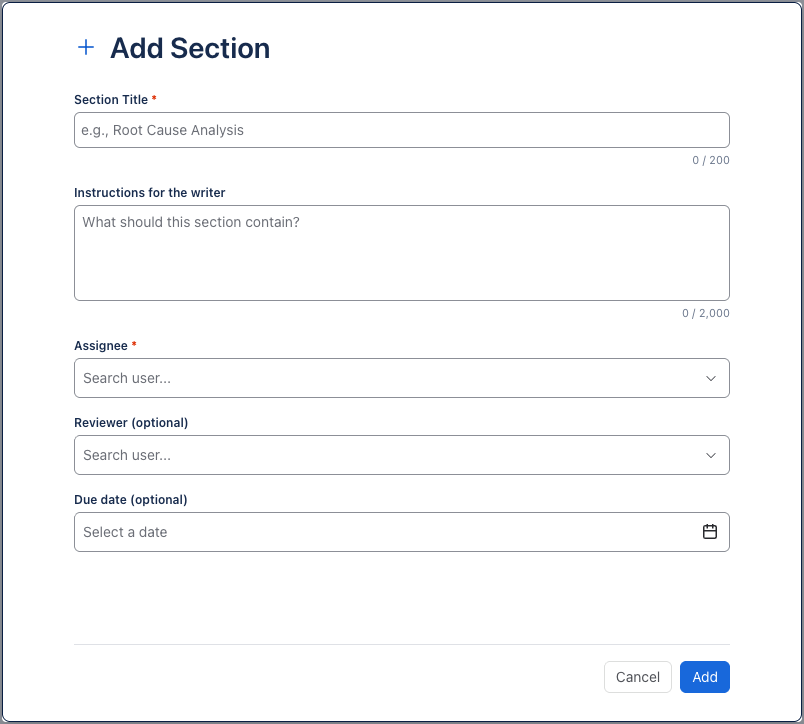
Click Add First Section and describe the work: a title (up to 200 characters), instructions for the writer (up to 2,000), a required assignee, an optional reviewer — a different person — and an optional due date. Repeat for each section; a page holds up to 50.

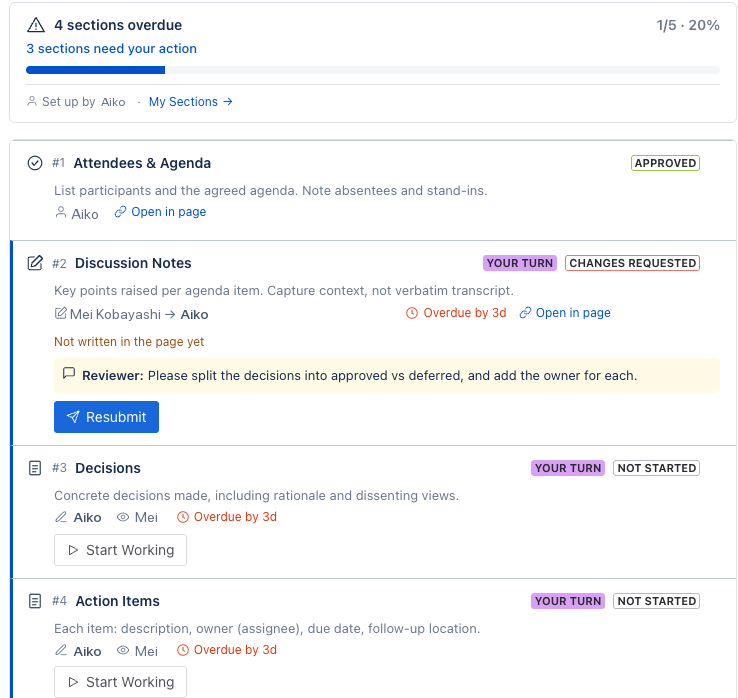
The macro becomes the page's status board: a progress bar with the completion count, cards numbered #1, #2, … with status lozenges from Not Started to Approved, and a purple Your Turn marker wherever you are the one holding things up. Overdue sections turn the header red — visible to everyone who opens the page.

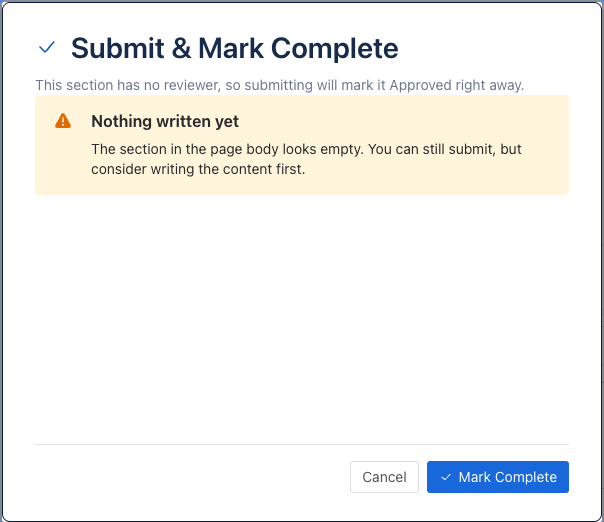
Start Working inserts a heading and a "Write here…" placeholder into the page body and opens the editor in a new tab. When the section is written, Submit for Review sends it to the reviewer with an optional note. No reviewer set? The dialog becomes Submit & Mark Complete and approves right away — and if the section body still looks empty, the app warns you before you submit.

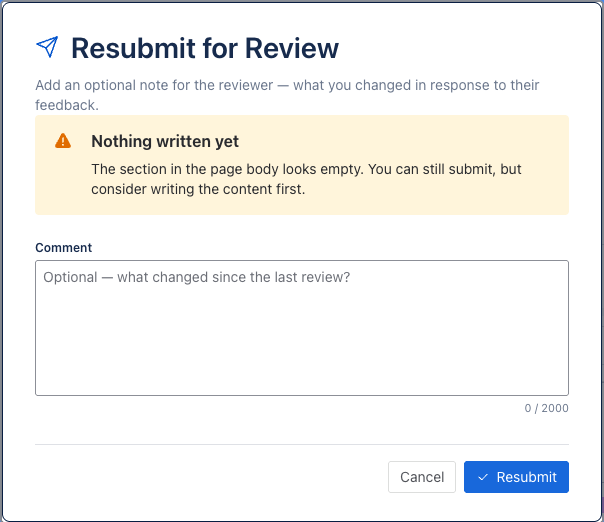
The reviewer sees Approve and Request Changes on the card. Requesting changes requires a comment — it lands on the card as reviewer feedback, the status flips to Changes Requested, and the writer answers with Resubmit, optionally noting what changed. Approved sections lock: nobody edits them, so a finished page stays finished.

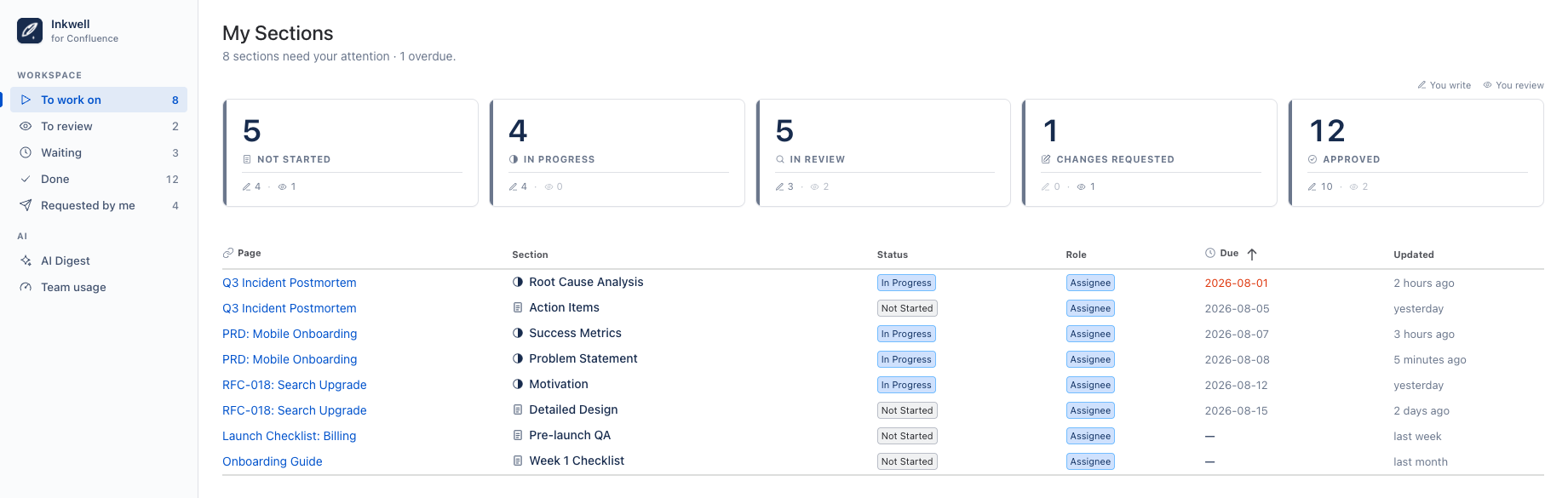
My Sections gathers everything with your name on it across every page: To work on, To review, Waiting, Done, and Requested by me, with status tiles split by write and review roles and a table sorted by due date. For anything overdue — or due within 24 hours — the app also posts an @mention comment on the page itself, so the nudge reaches people where they already are. The AI group in the sidebar adds two more views: AI Digest, which summarizes everything in flight into risks, bottlenecks, and next actions, and Team usage, which shows the team's shared monthly AI allowance.

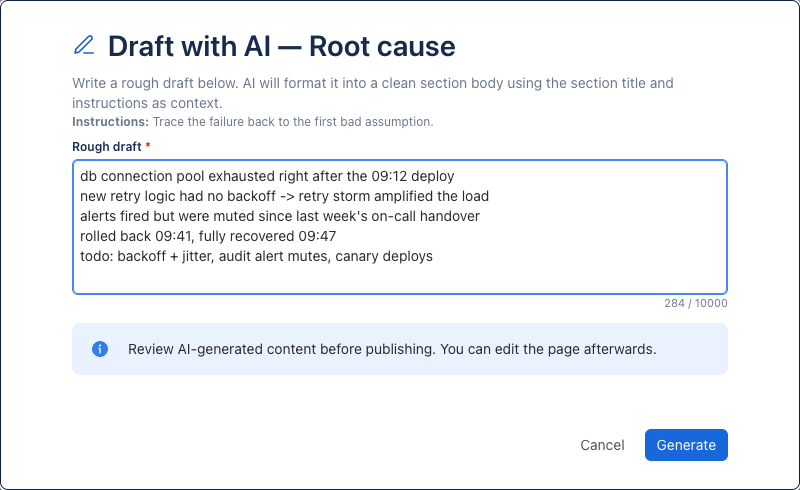
Every section you hold carries a Draft with AI button next to Submit for Review. Click it and hand over rough notes — bullet points, a timeline, half-sentences are all fine. The AI formats them into a clean section body, using the section's title and instructions as context, so the draft lands on target.


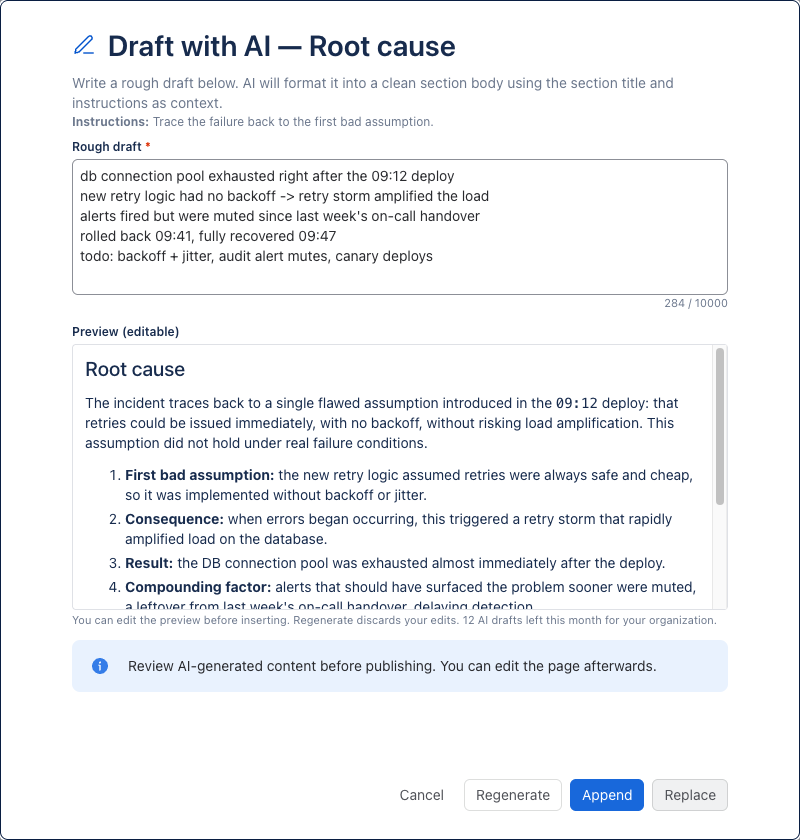
Generate returns a structured draft in an editable preview — nothing touches the page yet. Edit it in place, or Regenerate for a fresh take (that discards your edits). When it reads right, Append inserts it under the section heading and Replace swaps the section body. Review AI-generated content before publishing — afterwards the page stays editable, like any Confluence content.

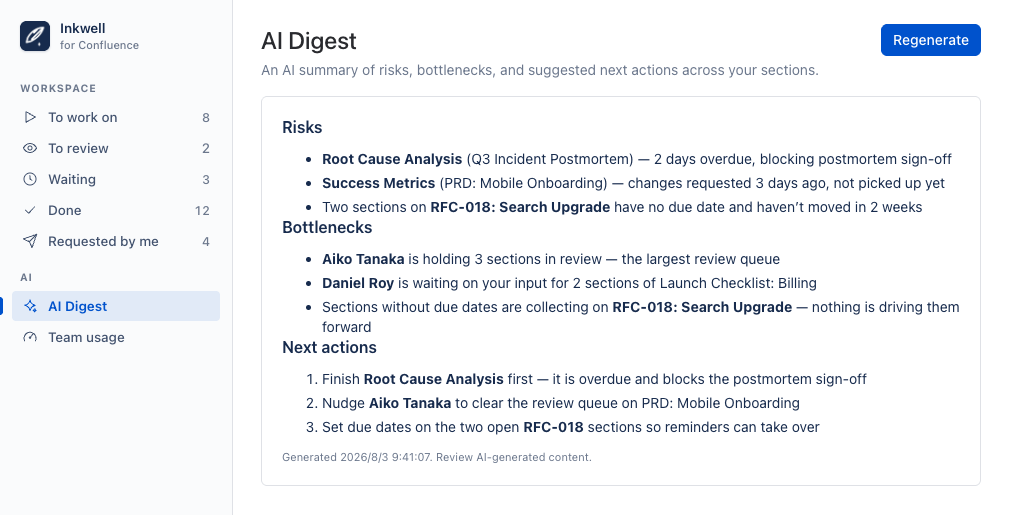
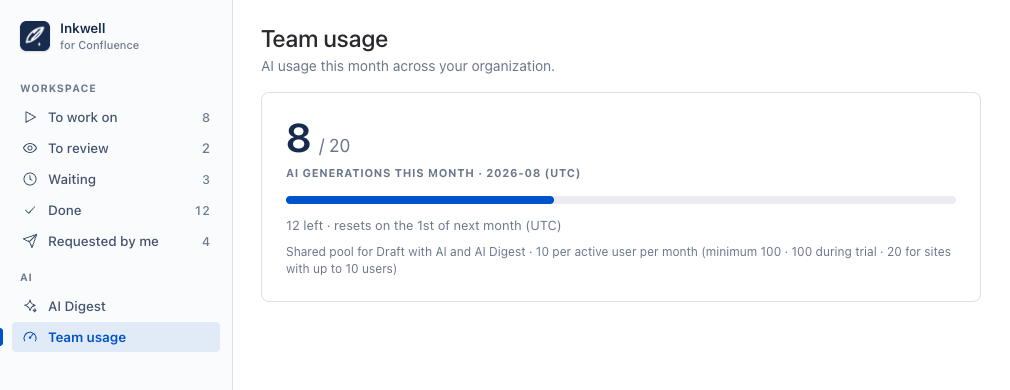
In the dashboard's AI group, AI Digest condenses everything in flight into risks, bottlenecks, and next actions — naming the sections and people involved — with Regenerate for when the picture changes. Team usage, beside it, shows the shared monthly pool that drafts and digests draw from, how much is left, and when it resets: visible to the whole team, so there are no surprises.


What each choice on a section does.
"Root Cause Analysis" tells a writer where to type; instructions tell them what good looks like. Two minutes spent on the instructions field saves a Changes Requested round-trip later.
Not every section needs a reviewer. Leave the reviewer empty on the routine ones and submitting marks them complete in one step — save the review loop for the sections where a second pair of eyes earns its keep.
Set a due date on the sections that matter and stop chasing people by hand: the page-top bar turns red, cards show Overdue by Nd, and the app posts an @mention comment on the page — before the deadline, and daily after it.
Ask the person who builds it. Replies are fast and specific.